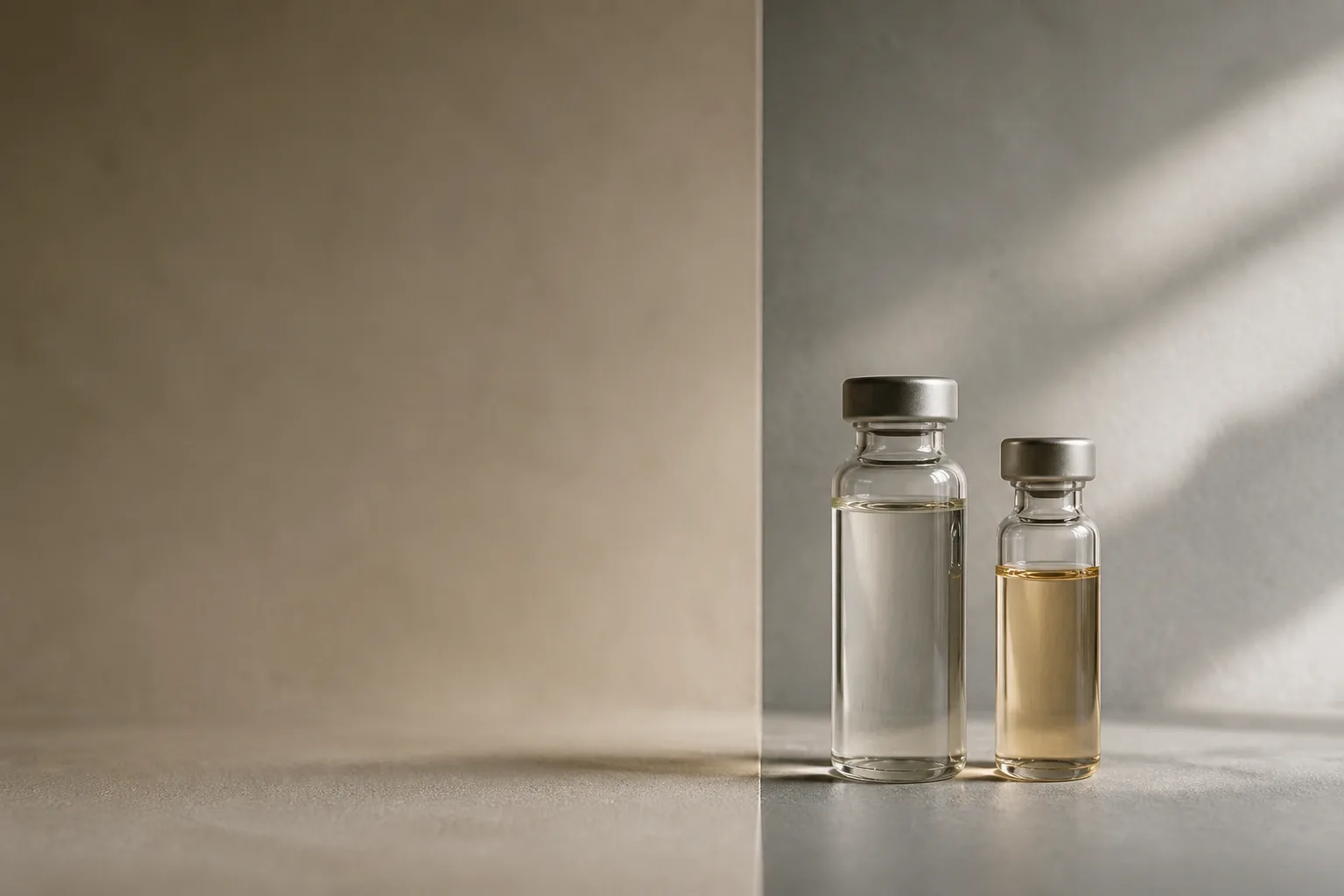
Ipamorelin vs CJC-1295: Which Growth Hormone Peptide Is the Better Choice After 45?
Two peptides. Two pathways. One quiet biological clock winding down inside every man past midlife. Here is what the research actually says about which one belongs in your protocol.
By the time a man crosses 45, something has already been slipping away for over a decade, silently, night after night, in the deepest minutes of his sleep. Growth hormone output fades roughly 14 percent per decade after 30, a slow fade doctors call the somatopause. Two peptides keep coming up as answers: Ipamorelin and CJC-1295. They take very different roads, and that difference is the whole story.
By the time a man crosses 45, something has already been slipping away for over a decade, silently, night after night, in the deepest minutes of his sleep.
Growth hormone is released in pulses, and the biggest one arrives during the first stretch of slow wave sleep. In your twenties those pulses were tall and frequent. Then, around age 30, the decline begins. Research puts the fall at roughly 14 percent per decade, and some data suggests output can drop by as much as half every seven years in adult men. By 60, many people carry growth hormone levels that are a fraction of what they made at 25, with no pituitary disease to blame at all. Doctors have a name for this slow fade: the somatopause.
The visible consequences read like a list of everything men over 45 complain about. Lean muscle thins out. Visceral fat settles around the middle. Recovery from a hard workout that used to take a day now takes three. Sleep gets lighter. Skin loses some of its thickness. It is against this backdrop that two peptides keep coming up in clinics, forums, and late night research binges: Ipamorelin and CJC-1295.
They do not add synthetic hormone to your body. They coax your own pituitary gland into releasing more of its own growth hormone, working with your physiology instead of overriding it. But they take very different roads to get there, and that difference is the whole story.
14%
GH Decline per Decade
after age 30
85%
of Men 59 to 98
have low IGF-1 vs younger men
35%
of Men 60+
found growth hormone deficient
50%
IGF-1 Fall from Peak
by age 60 to 70
Why the Decline Matters More After 45
The falloff is not linear in how it feels. In your thirties, a 14 percent dip is easy to ignore. By your mid forties, two decades of compounding decline have stacked up, and the gap between how your body performs and how it used to becomes hard to miss.
Growth Hormone Output Across a Man's Life
Ipamorelin: The Clean, On-Demand Pulse
Ipamorelin is a growth hormone secretagogue. In plain terms, it walks up to the ghrelin receptor, the same one your hunger hormone uses, and taps the pituitary on the shoulder to release a burst of stored growth hormone right now.
What makes it stand out is not raw power but manners. Ipamorelin is remarkably selective. It triggers a growth hormone pulse without meaningfully raising cortisol, prolactin, or ACTH, the stress and side effect hormones that clumsier secretagogues drag along with them. A 1999 human trial with 40 volunteers found that Ipamorelin produced biologically meaningful growth hormone release, with peak concentrations arriving inside an hour.
Its half life is short, measured in minutes to a couple of hours. That sounds like a weakness, but it is actually the design intent. Short and sharp means the pulse rises and falls the way a natural one does, then clears. Clinically it is talked about for recovery, deeper sleep, and fat reduction, the quality of life pillars that tend to erode first after 45.
CJC-1295: The Long, Steady Tide
CJC-1295 comes at the problem from the other direction. It is a synthetic analog of growth hormone releasing hormone, the hypothalamic signal that drives pulsatile GH secretion in the first place. Instead of forcing an immediate burst, it lifts the amplitude and duration of the pulses your body is already trying to make.
Here is where it splits into two very different tools. The version with DAC, a drug affinity complex that binds to albumin in the blood, has an estimated half life of roughly 6 to 8 days. In the original human pharmacology work, a single subcutaneous dose raised mean growth hormone 2 to 10 fold for six days or more and lifted IGF-1 by 1.5 to 3 fold for 9 to 11 days. With repeated weekly or biweekly dosing, IGF-1 stayed above baseline for up to 28 days.
The version without DAC, often called Modified GRF 1-29, is short acting like Ipamorelin. It gives a brief pulse and is dosed more frequently, usually before bed or after training, to line up with the body's natural rhythm. This is the form most physicians now reach for, because a short, pulsatile signal looks more like real physiology than a flat, sustained one. That distinction matters: continuous GH elevation tends to breed more insulin resistance and receptor downregulation than pulsatile release does.
CJC-1295 is really two different drugs sharing a name. The DAC version is a once weekly, set and forget tide. The no-DAC version is a fast, bedtime pulse. When people online argue about CJC-1295, they are often arguing about two tools that behave nothing alike.
How the Two Peptides Actually Differ
Strip away the marketing and the comparison comes down to a handful of concrete properties. Here is the side by side.
Ipamorelin vs CJC-1295: Property by Property
| Property | Ipamorelin | CJC-1295 |
|---|---|---|
| Mechanism | Ghrelin receptor secretagogue (pulse trigger) | GHRH analog (pulse amplifier) |
| Half life | About 2 hours (short) | 6 to 8 days with DAC; minutes to hours without |
| Release pattern | Sharp, immediate burst | Sustained elevation (DAC) or short pulse (no DAC) |
| Typical dosing | 1 to 3 times daily | Weekly (DAC) or daily (no DAC) |
| Best known for | Recovery, sleep, fat loss | Lean muscle, anti-aging, sustained IGF-1 |
| Selectivity | High; spares cortisol and prolactin | Acts on GHRH pathway; preserves pulsatility |
| Common side effects | Mild water retention, headache, injection redness | Injection irritation, short term fatigue, water retention |
| Used alone? | Rarely; usually the partner half | Sometimes, but commonly paired |
Reading the Release Curve
The single clearest way to feel the difference is to watch how each peptide moves growth hormone through a 24 hour window. The DAC version holds a flat, sustained plateau. The short acting agents and the stack fire in sharp bedtime and post training pulses.
Growth Hormone Signal Over 24 Hours (Relative Activity, 0 to 10)
- Ipamorelin
- CJC-1295 (no DAC)
- CJC-1295 (with DAC)
- The Stack
What the IGF-1 Numbers Show
Growth hormone itself is hard to measure because it comes and goes in pulses. So researchers track IGF-1, the downstream hormone GH stimulates, which stays elevated long enough to give a stable reading. It is the closest thing to a scoreboard for these peptides. The CJC-1295 human data is the most concrete.
How Long IGF-1 Stays Above Baseline (CJC-1295)
A word of realism here. Observational body composition data on the CJC-1295 and Ipamorelin combination describes modest single digit reductions in body fat over three to six month protocols, not the dramatic before and after physiques that informal sources promise. The peptides amplify what training, protein, and sleep are already doing. They do not replace the work.
Why Versus Is the Wrong Question
Here is the part that trips people up. In actual clinical practice, Ipamorelin is rarely prescribed alone. It is almost always the other half of a CJC-1295 stack. The two are not really rivals; they are two instruments in the same section of the orchestra.
The logic is mechanical. CJC-1295 raises the ceiling and duration of each pulse through the GHRH pathway. Ipamorelin pulls the trigger on that pulse through the ghrelin pathway. Run together, they produce a growth hormone release larger than either one makes alone, which is why clinicians describe the combination as synergistic. One amplifies, the other initiates. The result is a bigger, cleaner pulse that still rises and falls like a natural one.
So when a man over 45 asks which is better, the honest response from most experienced providers is that the framing itself is off. The relevant question is which role each peptide plays, and whether your own labs, symptoms, and goals call for one, the other, or the pair.
What Each Peptide Contributes to the Stack (0 to 10)
| Outcome | Ipamorelin | CJC-1295 |
|---|---|---|
| Fast pulse trigger | 9 | 4 |
| Sustained IGF-1 | 3 | 9 |
| Sleep & recovery | 8 | 5 |
| Lean mass support | 5 | 8 |
| Fat reduction | 7 | 6 |
| Dosing convenience | 4 | 8 |
So Which Fits Which Man?
If your chief complaints are wrecked sleep, slow recovery, and stubborn fat, the Ipamorelin side of the equation is doing the heavy lifting, and a short acting no-DAC pairing keeps everything close to natural rhythm. If your priority is sustained IGF-1 support, lean mass, and the broader anti-aging arc, CJC-1295 is carrying more of the load, and the DAC version offers convenience at the cost of some physiologic realism.
Neither peptide wins. The most common, most defensible modern choice is the CJC-1295 plus Ipamorelin stack, dosed to preserve the body's natural pulsatile rhythm. Ipamorelin supplies the clean trigger and the sleep and recovery benefits men notice first. CJC-1295 supplies the sustained IGF-1 signal that supports lean mass and the slower anti-aging story. If forced to pick a single agent, the decision follows your dominant symptom, not a leaderboard, and a licensed provider reads your labs before anything gets drawn into a syringe.
Frequently Asked Questions
This article is for educational purposes only and is not medical advice. There is no FDA approved CJC-1295 or Ipamorelin product, and the dosing patterns described reflect clinical and observational literature, not official guidelines. Peptides affect your hormonal system and are not risk free. They are inappropriate for anyone with active malignancy, since elevated IGF-1 may stimulate tumor growth, among other contraindications. Any protocol should be started and supervised by a licensed medical provider who has reviewed your individual labs, symptoms, and history.
Continue Reading
Related Articles
Sermorelin vs. Ipamorelin: Which GH Peptide Is Right for You? (2026 Guide)
15 min read

How Age Affects Testosterone, and What You Can Do Starting in Your 30s
9 min read
The Longevity Stack for Men Over 50
9 min read
Best Peptides to Stack with TRT: The Complete 2026 Protocol Guide
8 min read