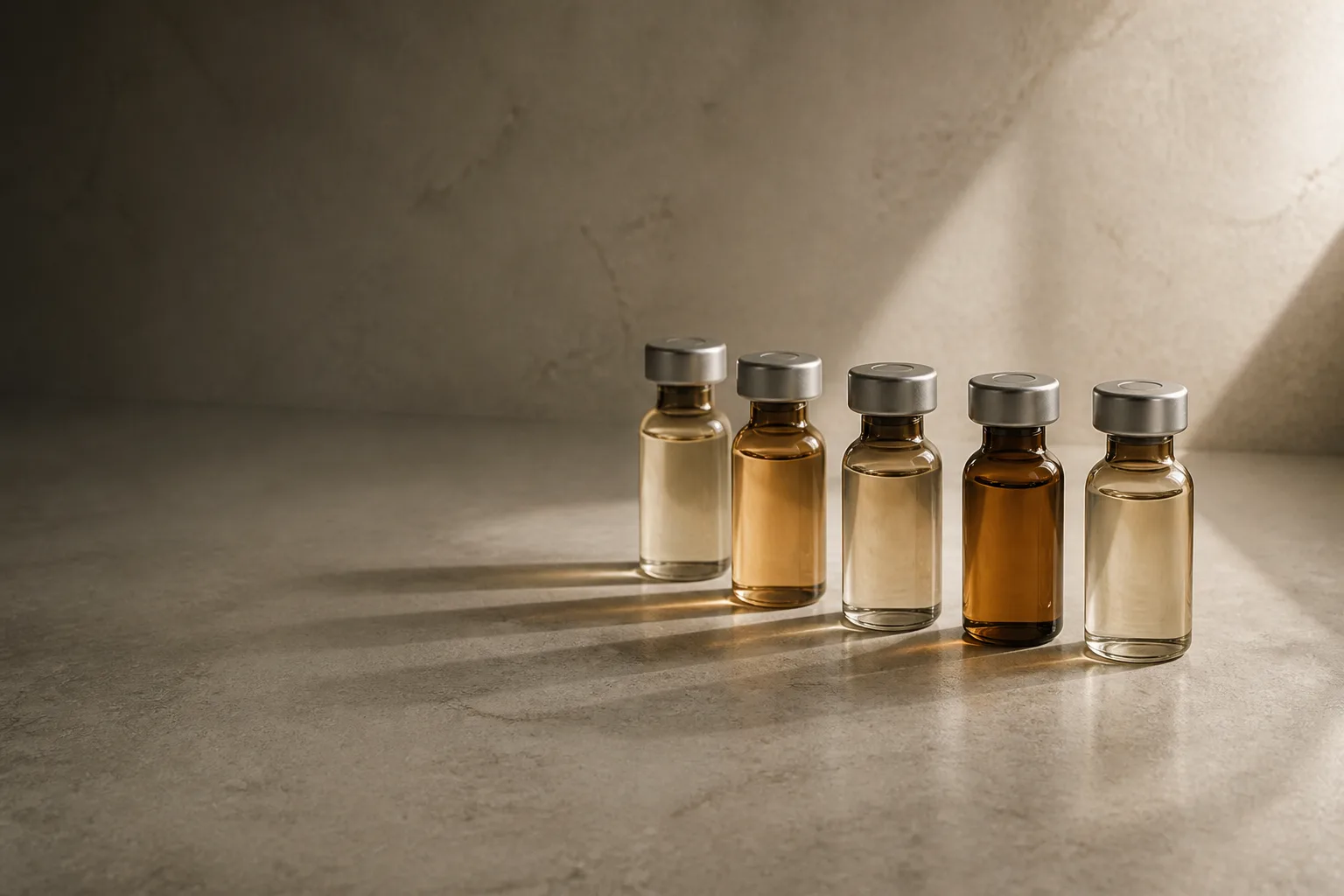
The Longevity Stack for Men Over 50
Epithalon, Thymosin Alpha-1, and GHK-Cu each target a different clock inside the aging body. Combined, they form one of the most talked about protocols in the field. Here is what the research actually shows.
By fifty, the body keeps a set of quiet clocks. One counts down the protective caps on your chromosomes. Another marks the slow shrinking of the thymus. A third runs through the skin and connective tissue. The three peptide protocol at the center of longevity conversations tries to reach into each of those clocks at once, with three targeted tools rather than one magic compound.
By fifty, the body keeps a set of quiet clocks. One counts down the protective caps on your chromosomes. Another marks the slow shrinking of the thymus, the small gland behind the breastbone that trains your immune cells. A third runs through the skin and connective tissue, where collagen thins a little more each year. None of these clocks announce themselves. They simply tick.
The three peptide protocol that has moved to the center of longevity conversations tries to reach into each of those clocks at once. Epithalon works on the chromosome caps. Thymosin Alpha-1 works on the immune training gland. GHK-Cu works on the skin and tissue. The idea is not one magic compound. It is three targeted tools, each with its own body of evidence, pointed at three different mechanisms of getting older.
What follows is a grounded look at what each one does, what the numbers say, how they fit together, and where the science is still thin. None of these are approved by the United States FDA for anti-aging, and this is educational reading, not a prescription. With that said, the data is more interesting than the hype usually admits.
33%
Telomere Length Increase
with Epithalon in human lymphocyte studies
35+
Countries
where Thymosin Alpha-1 is an approved drug
31%
Wrinkle Reduction
from GHK-Cu in a 2024 controlled trial
Three Clocks, Three Tools
Aging is not a single process. Researchers describe it as a set of overlapping mechanisms, sometimes called the hallmarks of aging. The value of this stack is that its three parts do not overlap much. Each addresses a distinct hallmark, which is why they are combined rather than swapped.
What Each Peptide Actually Targets
| Peptide | Mechanism Targeted | Detail |
|---|---|---|
| Epithalon | Telomeres & telomerase | Targets the chromosome caps that shorten with every cell division |
| Thymosin Alpha-1 | Immune & T cell function | Restores immune training as the thymus gland shrinks with age |
| GHK-Cu | Collagen & connective tissue | Resets skin and tissue gene expression toward a younger pattern |
Think of it as a division of labor. Epithalon works at the level of the cell nucleus. Thymosin Alpha-1 works at the level of the immune system. GHK-Cu works at the level of visible tissue. A man in his fifties is usually losing ground on all three fronts at the same time, which is the argument for running them together rather than one at a time.
Epithalon and the Chromosome Clock
Epithalon, also spelled Epitalon, is a synthetic tetrapeptide. That means it is just four amino acids strung together: alanine, glutamate, aspartate, and glycine. It was developed by Professor Vladimir Khavinson at the St. Petersburg Institute of Bioregulation and Gerontology, based on a natural pineal gland compound called Epithalamin.
Its headline mechanism is telomerase activation. Telomeres are the protective caps at the ends of your chromosomes. Every time a cell divides they get a little shorter, and once they wear down past a critical point the cell stops dividing or dies. This is one of the most studied hallmarks of aging. Epithalon appears to switch on telomerase, the enzyme that rebuilds those caps.
In a landmark laboratory study, Khavinson's group showed that Epithalon increased telomerase activity in human fibroblast cells and pushed them past the normal division limit, extending their working lifespan from 34 divisions to beyond 44. In human lymphocyte work, treated cells showed an average telomere length increase of about 33 percent. That is a striking number, though it comes largely from Eastern European research groups and cell and animal models rather than large Western clinical trials.
Epithalon in the Lab: Cell Division Capacity (Human Fibroblasts)
One point the researchers stress is that more is not better. Trials that pushed the dose as high as 50 mg per day did not produce stronger or longer lasting results than the standard 5 to 10 mg range. Epithalon seems to normalize telomerase rather than force it into overdrive, which matters because runaway telomerase is a feature of cancer cells. Reassuringly, animal studies did not show increased tumor rates, and some actually reported fewer tumors, possibly because healthier immune cells clear damaged cells better.
The common research convention is 5 mg per day, split morning and evening, run as a 10 to 20 day course, then repeated every 4 to 6 months rather than taken continuously. Telomerase effects are reported to persist for months after a cycle ends.
Thymosin Alpha-1 and the Immune Clock
If Epithalon is the most speculative of the three, Thymosin Alpha-1 is by far the most clinically validated. It is a 28 amino acid peptide your thymus gland makes naturally to help train immune cells. The catch is that the thymus starts shrinking after your twenties, a process called thymic involution, and its output of this peptide falls with it. That decline tracks closely with the weakening immune function seen in older age, sometimes called immunosenescence.
The synthetic version is sold as Zadaxin, or thymalfasin, and it is a genuine approved pharmaceutical in more than 35 countries for chronic hepatitis B, hepatitis C, and as an immune support during cancer care. It has been studied in over 11,000 patients across more than 30 clinical trials, with serious adverse events reported in under 1 percent. Among the peptides in this stack, that is an unusually deep evidence base.
Thymosin Alpha-1 in Chronic Hepatitis B: Sustained Response at 72 Weeks
Its mechanism is worth understanding because it is not a simple immune booster. Thymosin Alpha-1 promotes the maturation of T cells, activates dendritic cells, increases natural killer cell activity, and signals through toll-like receptors. Crucially, it modulates rather than simply revs up. It helps the immune system find balance between under-response and overreaction, which is why researchers see it as well suited to age related immune decline rather than a blunt stimulant.
You do not feel this one working the way you might feel a stimulant. The benefits show up over weeks to months as fewer and milder infections, better recovery from illness, and improved response to vaccines, measured in immune markers like T cell counts rather than as an immediate sensation.
GHK-Cu and the Tissue Clock
GHK-Cu is a copper binding peptide that occurs naturally in human plasma, and here is the unsettling part. Its concentration in your blood drops sharply with age, falling roughly by half between your twenties and your sixties. It is one of the most studied peptides in the skin and regeneration literature, with more than 50 years of published work behind it.
It works partly through epigenetics. Gene mapping data suggests GHK-Cu can reset expression across a large share of human genes toward a younger, healthier pattern, and it regulates the enzymes that break down collagen and elastin. In plain terms, it tells aging skin and connective tissue to behave more like younger tissue.
The clinical numbers are among the cleaner ones in this whole stack because skin is easy to measure. A 2024 randomized controlled trial in 60 women aged 40 to 65 applied a 0.1 percent GHK-Cu cream twice daily for 12 weeks. The result was 31 percent wrinkle reduction and 28 percent improved elasticity against placebo, with collagen density up nearly 16 percent on ultrasound. A separate ultrasound study using daily application reported an average 28 percent rise in collagen density over three months, and the top quarter of participants saw improvements around 51 percent.
GHK-Cu Skin Outcomes vs Placebo (Controlled Topical Trials)
For a man over 50, the appeal is not only cosmetic. Collagen and connective tissue quality affect joints, tendons, and wound healing, not just the face. GHK-Cu is most often used topically, which keeps it low risk, though some research protocols use subcutaneous injection for more systemic effects.
Reading the Evidence Honestly
The three peptides are not equal in how well they are proven, and pretending otherwise is where the marketing usually goes wrong. Thymosin Alpha-1 sits on the strongest ground as an approved drug with a large trial database. GHK-Cu has solid, repeatable human skin data. Epithalon is the most mechanistically exciting and the most overhyped, with genuine animal evidence but thin human trial data drawn mostly from a single research lineage.
Evidence Strength by Peptide (Scored Out of 100)
None of the three is FDA approved for longevity or anti-aging. That is not the same as saying they do nothing. It means the specific claim of extending human lifespan has not been proven in the kind of large, long, randomized trials that approval requires, largely because those trials would take decades and are expensive to run for compounds that cannot be strongly patented.
How the Stack Is Put Together
Because the three peptides act on different systems, researchers generally consider them compatible rather than competing. The stack is often described as targeting three pillars that deteriorate most after 50: immune decline, cellular aging, and tissue quality. Below is a representative research protocol drawn from published guides. Read it as a map of how the pieces fit, not as personal instructions.
A Representative Research Protocol
| Peptide | Target Clock | Typical Research Schedule | Route |
|---|---|---|---|
| Epithalon (cellular) | Telomeres and telomerase | 5 mg daily, 10 to 20 day course, every 4 to 6 months | Subcutaneous |
| Thymosin Alpha-1 (immune) | Thymic and T cell decline | 1.6 mg, two to three times weekly, ongoing | Subcutaneous |
| GHK-Cu (tissue) | Collagen, skin, connective tissue | Topical daily, or 1 to 2 mg subcutaneous | Topical or SubQ |
The most common piece of advice across the research literature is to start with a single peptide, assess how you tolerate it, and only then consider combining. Conservative dosing is emphasized for this age group specifically, since lower doses than the ones circulated online are often enough and carry less risk.
What Men Over 50 Should Weigh First
- Get baseline bloodwork before starting anything. Common panels include CBC, fasting glucose, and a metabolic panel, rechecked periodically.
- Polypharmacy is the real risk in this age group. Peptides can interact with blood pressure drugs, statins, and anticoagulants, so a physician review matters more than at 30.
- Thymosin Alpha-1 needs specialist input for anyone with autoimmune disease or on immunosuppression, since it modulates immune activity.
- None of these are FDA approved for anti-aging. Sourcing quality varies widely and is a genuine safety variable.
- Work with an experienced healthcare provider to design any combination protocol. This article is educational and not medical advice.
The Honest Bottom Line
This is not a miracle stack, and anyone selling it as one is ahead of the evidence. What it is, more fairly, is three targeted tools aimed at three real and distinct mechanisms of aging, with a range of evidence quality behind them. Thymosin Alpha-1 is a proven immune drug used worldwide. GHK-Cu has clean, repeatable skin data. Epithalon is a genuinely intriguing longevity idea whose human evidence has not yet caught up to its mechanism.
For a man over 50 thinking about this seriously, the smart move is the unglamorous one. Start with bloodwork, start with one compound, keep the doses conservative, and involve a doctor who understands both the peptides and your medications. The clocks will keep ticking either way. The question is only how carefully you decide to respond.
Frequently Asked Questions
This article is for educational purposes only and is not medical advice, diagnosis, or a treatment recommendation. The peptides discussed are not approved by the United States FDA for anti-aging or longevity. Consult a qualified healthcare provider before considering any protocol, particularly if you take other medications or have existing health conditions. Statistics cited are drawn from published research current as of July 2026.
Continue Reading
Related Articles

Epithalon: The Soviet Longevity Peptide Men Are Using to Slow Aging in 2026
12 min read
Thymosin Alpha-1: The Immune Peptide Every Man Over 40 Should Know About
12 min read

GHK-Cu: The Copper Peptide the Anti-Aging Industry Does Not Want You to Inject
12 min read
Best Peptides to Stack with TRT: The Complete 2026 Protocol Guide
8 min read