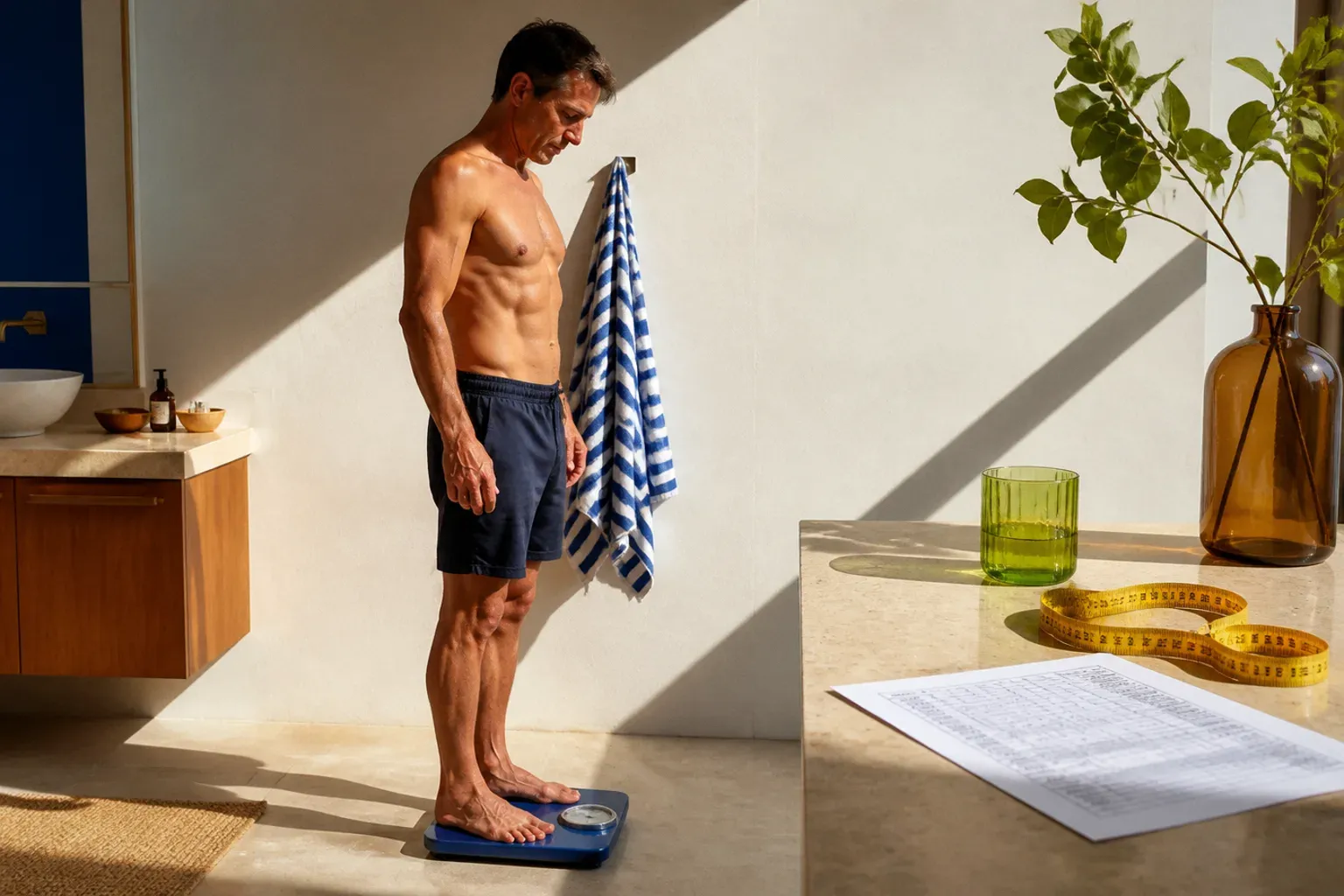
Does Losing Weight Raise Testosterone? What Men Over 40 Can Expect From Diet, GLP-1 Drugs and Surgery
Extra fat drags testosterone down, and losing it gives some of it back. The trials show how much each approach returns, and why the scale matters more than the method.
Losing weight does raise testosterone in men carrying excess fat. Across 44 studies, a low-calorie diet added 2.5 nmol/L of total testosterone and bariatric surgery added 7.2 nmol/L, and the more weight men lost, the more testosterone came back.
Does losing weight raise testosterone? For men carrying excess body fat, the answer from the research is yes, and the size of the rise tracks the amount of weight lost. A 2013 meta-analysis by Corona and colleagues in the European Journal of Endocrinology found that total testosterone rose 2.87 nmol/L after a low-calorie diet and 8.73 nmol/L after bariatric surgery. The degree of weight loss was the best predictor of how much testosterone came back.
That matters for men over 40 because low testosterone and a growing waistline often arrive together, and the usual response is a prescription. This guide covers why fat lowers testosterone, how much each kilo is worth, how diet, exercise, GLP-1 medicines and surgery compare, and when testosterone therapy still makes sense. Every figure comes from peer-reviewed studies opened and checked for this article.
2.5
nmol/L Gain From Dieting
Total testosterone, 19 low-calorie diet studies (Ken-Dror, Andrology 2024)
7.2
nmol/L Gain From Surgery
Total testosterone, 26 bariatric surgery studies (Ken-Dror, Andrology 2024)
14%
Rise in Men With Diabetes
Year 1 of the Look AHEAD lifestyle program, 890 men (Bennett, JCEM 2025)
15%
Weight Change Threshold
Needed before free testosterone moved in the EMAS cohort (Camacho, EJE 2013)
2.42
nmol/L Lower per SD of BMI
21,074 men pooled across 9 cohorts (Marriott, Ann Intern Med 2023)
Why Does Excess Body Fat Lower Testosterone?
Excess body fat lowers testosterone mainly by lowering SHBG, the protein that carries testosterone in the blood. A 2025 Approach to the Patient review by Muir, Wittert and Handelsman in the Journal of Clinical Endocrinology and Metabolism states that obesity-related drops in SHBG are primarily responsible for the lower testosterone readings seen in heavier men. When LH and FSH, the pituitary signals, are normal, the authors describe the pattern as the pseudo-hypogonadism of obesity rather than true testicular failure.
The link between body size and testosterone is one of the strongest in the hormone literature. Marriott and colleagues pooled individual data from 21,074 men in 9 cohort studies, published in the Annals of Internal Medicine in 2023. Total testosterone was 2.42 nmol/L lower for every standard deviation increase in BMI, while age made little difference between 17 and 70. Diabetes was associated with testosterone 1.43 nmol/L lower.
Illustration: How Weight Gain Is Thought to Pull Testosterone Down
Fat gain
Waist and visceral fat grow
Fat inside the abdomen expands faster than fat under the skin in many men.
SHBG falls
Less carrier protein
Lower SHBG means a lower total testosterone reading on the lab report.
Signals blunted
Brain-testis loop dampens
In heavier men, the pituitary drive to the testicles can weaken.
Reversal
Weight loss undoes much of it
SHBG, gonadotropins and testosterone rise as weight comes off.
Does Losing Weight Raise Testosterone, and by How Much?
Losing weight raises total testosterone by roughly 2.5 nmol/L with dieting and 7.2 nmol/L with bariatric surgery, according to the largest pooled analysis. Ken-Dror and colleagues combined 44 studies with 1,774 participants, published in Andrology in 2024. Across all methods, total testosterone rose 4.8 nmol/L. The median follow-up was 26 weeks, so these are changes seen within about six months to a year.
Average Rise in Total Testosterone After Weight Loss (Source: Ken-Dror et al., Andrology 2024, 44 studies)
Free testosterone, the unbound fraction that reaches tissues, rose as well in the Ken-Dror analysis. It increased by 19.9 pmol/L after dieting, 58.0 pmol/L after surgery and 42.2 pmol/L overall. Men with a higher starting BMI, lower SHBG or lower starting testosterone gained the most, which means the men with the most to lose also had the most to gain.
Average Rise in Free Testosterone After Weight Loss (Source: Ken-Dror et al., Andrology 2024)
Do men over 40 respond differently?
Men over 40 responded in a slightly different way from younger men in the Ken-Dror nomograms. For the same amount of weight loss, men older than 40 gained more total testosterone but less free testosterone than men aged 40 or younger. The practical message is that age does not block the benefit; it changes which number on the lab report moves most.
How Much Weight Do You Need to Lose Before Testosterone Moves?
Total testosterone moves in proportion to weight change, but free testosterone may need a larger shift. The European Male Ageing Study followed 2,736 men aged 40 to 79 across eight European centres for a mean of 4.4 years, reported by Camacho and colleagues in the European Journal of Endocrinology in 2013. Weight loss was linked to a proportional rise in testosterone and SHBG, and weight gain to a proportional fall.
Free testosterone behaved differently in the EMAS data. Only men who gained or lost at least 15% of their body weight showed a significant change in free testosterone. That is a large loss for most men, which helps explain why modest diets often improve total testosterone on paper while men report feeling little different.
Does Losing Belly Fat Specifically Increase Testosterone?
Losing belly fat is linked to higher testosterone, but losing fat under the skin counts too. In the Diabetes Prevention Program, Kim and colleagues measured abdominal fat by CT scan in 246 overweight men with impaired glucose tolerance, published in the Journal of Clinical Endocrinology and Metabolism in 2017. Over 1 year, reductions in both visceral fat and subcutaneous fat were each independently associated with increases in total testosterone and SHBG.
Waist size appears to be the link in men with diabetes. The Look AHEAD Sex Hormone Study, published by Bennett and colleagues in the Journal of Clinical Endocrinology and Metabolism in 2025, followed 890 men with type 2 diabetes and a mean age of 60. The intensive lifestyle program raised testosterone by 14% and SHBG by 18% at year 1, and change in waist circumference was a significant mediator. Our guide to waist-to-height ratio explains how to track that number at home.
Does the testosterone rise last?
The testosterone rise from lifestyle change did not hold its full size in Look AHEAD. The effect was attenuated over 4 years, and change in waist size was the main mediator of the hormone shift. The EMAS data add that weight gain was linked to falling testosterone, which suggests the benefit depends on keeping the lower weight.
Diet, Exercise, GLP-1 Medicines or Surgery: Which Raises Testosterone Most?
Bariatric surgery raises testosterone most, because it produces the most weight loss. In the Corona 2013 meta-analysis of 24 studies, selected from 266 articles, surgery added 8.73 nmol/L of total testosterone against 2.87 nmol/L for a low-calorie diet. A 2026 umbrella review by Nayak and colleagues in Endocrine Practice reported bariatric surgery raised SHBG by up to 21.22 nmol/L and called it the most consistent intervention for sex hormones.
Total Testosterone Gain by Weight Loss Method (Source: Corona et al., Eur J Endocrinol 2013, 24 studies)
The type of operation may matter. A 2025 meta-analysis by Diniz and colleagues in Obesity Surgery compared Roux-en-Y gastric bypass with sleeve gastrectomy or gastric banding. Gastric bypass produced a testosterone rise 113.07 ng/dL greater than the other procedures, though the studies varied widely and the authors urged caution.
GLP-1 medicines such as semaglutide and tirzepatide are newer to this research. A 2026 meta-analysis by Corona and colleagues in Andrology found eight studies with 375 men on GLP-1 receptor agonists. These drugs significantly raised total and calculated free testosterone along with LH and FSH, and the authors reported that the effect appeared independent of the weight lost. The studies were small, and long-term randomized data in men over 40 are still limited. Our article on combining TRT and GLP-1 medicines covers how the two are used together.
How the Main Weight Loss Approaches Compare for Testosterone
| Approach | What the research found | Source |
|---|---|---|
| Low-calorie diet | Total testosterone up 2.5 nmol/L, free testosterone up 19.9 pmol/L | Ken-Dror, Andrology 2024 |
| Intensive lifestyle program (type 2 diabetes) | Testosterone up 14% and SHBG up 18% at year 1, fading over 4 years | Bennett, JCEM 2025 |
| GLP-1 receptor agonists | Total and free testosterone rose in 8 small studies of 375 men | Corona, Andrology 2026 |
| Bariatric surgery | Total testosterone up 7.2 nmol/L, free testosterone up 58.0 pmol/L | Ken-Dror, Andrology 2024 |
| Gastric bypass vs sleeve or band | Bypass added 113.07 ng/dL more, with high variability | Diniz, Obes Surg 2025 |
Should You Take Testosterone While You Diet?
Testosterone therapy during and after a diet helped men regain lean mass in one well-run trial, but it is not a substitute for losing the weight. Ng Tang Fui and colleagues randomized 100 obese men with a BMI of 30 or more and total testosterone at or below 12 nmol/L, median age 53, published in BMC Medicine in 2016. All followed a 10-week very low energy diet and then 46 weeks of weight maintenance, with 56 weeks of testosterone undecanoate or placebo; 82 men completed the study.
Both groups lost similar lean mass during the diet: 3.9 kg with testosterone and 4.8 kg with placebo. During maintenance, the testosterone group regained 3.3 kg of lean mass, while the placebo group regained 0.8 kg. By the end, the testosterone group had lost 2.9 kg more fat and kept 3.4 kg more lean mass than the placebo group, so their weight loss came almost entirely from fat.
Lean Mass Lost on the Diet and Regained in Maintenance (Source: Ng Tang Fui et al., BMC Med 2016)
Muir, Wittert and Handelsman take a firm line on the bigger question. In men with obesity and no structural cause of low testosterone, they write that testosterone treatment is not indicated and works less well than diet and lifestyle change. They list the risks of unneeded therapy as infertility, a raised hematocrit that may require blood removal, a higher clotting tendency and testosterone dependence. Men with true hypogonadism, confirmed by repeat testing and pituitary hormones, are a different group.
Illustration: A Sensible Order of Steps for a Heavier Man With Low Testosterone
First
- ✓Repeat an early-morning, fasting total testosterone
- ✓Ask for SHBG, free testosterone, LH and FSH
- ✓Note waist size and body weight on the same day
Next
- ✓Screen for sleep apnea and type 2 diabetes
- ✓Review alcohol intake and medications
- ✓Start a calorie deficit with high protein and resistance training
Then
- ✓Discuss GLP-1 medicines with a doctor if eligible
- ✓Discuss bariatric surgery if BMI and health history qualify
- ✓Keep lifting to protect lean mass
Recheck
- ✓Repeat testosterone, SHBG and LH at the lower weight
- ✓Reassess symptoms such as libido and energy
- ✓Talk about TRT only if levels and symptoms stay low
The Number to Watch
A low total testosterone in a heavy man is often a low SHBG reading, not failing testicles. Ask for SHBG, free testosterone and LH before accepting a diagnosis, and remember that the strongest predictor of a testosterone rise in the Corona meta-analysis was simply how much weight came off. Decisions about hormone therapy belong with a licensed clinician who has seen your full lab panel.
This article is for educational purposes only and is not medical advice. It does not diagnose, treat, cure or prevent any disease. Talk to a doctor before starting a very low calorie diet, a weight loss medicine or testosterone therapy, especially if you have diabetes or heart disease.
Sources
- Corona G et al. Body weight loss reverts obesity-associated hypogonadotropic hypogonadism: a systematic review and meta-analysis. European Journal of Endocrinology, 2013. https://doi.org/10.1530/EJE-12-0955
- Ken-Dror G et al. Meta-analysis and construction of simple-to-use nomograms for approximating testosterone levels gained from weight loss in obese men. Andrology, 2024. https://doi.org/10.1111/andr.13484
- Camacho EM et al. Age-associated changes in hypothalamic-pituitary-testicular function in middle-aged and older men are modified by weight change and lifestyle factors: longitudinal results from the European Male Ageing Study. European Journal of Endocrinology, 2013. https://doi.org/10.1530/EJE-12-0890
- Marriott RJ et al. Factors Associated With Circulating Sex Hormones in Men: Individual Participant Data Meta-analyses. Annals of Internal Medicine, 2023. https://doi.org/10.7326/M23-0342
- Muir CA, Wittert GA, Handelsman DJ. Approach to the Patient: Low Testosterone Concentrations in Men With Obesity. Journal of Clinical Endocrinology and Metabolism, 2025. https://doi.org/10.1210/clinem/dgaf137
- Kim C et al. Changes in Visceral Adiposity, Subcutaneous Adiposity, and Sex Hormones in the Diabetes Prevention Program. Journal of Clinical Endocrinology and Metabolism, 2017. https://doi.org/10.1210/jc.2017-00967
- Bennett WL et al. Weight Loss Differentially Impacts Sex Hormones in Women and Men With Type 2 Diabetes: Look AHEAD Sex Hormone Study. Journal of Clinical Endocrinology and Metabolism, 2025. https://doi.org/10.1210/clinem/dgae584
- Nayak SS et al. The Effect of Weight Loss and Weight Loss Interventions on Sex Hormones: An Umbrella Review of Systematic Reviews and Meta-Analyses. Endocrine Practice, 2026. https://doi.org/10.1016/j.eprac.2025.10.014
- Diniz RP et al. Effects of different Metabolic Bariatric Surgeries in Testosterone Levels: A Systematic Review and Meta-Analysis. Obesity Surgery, 2025. https://doi.org/10.1007/s11695-025-07839-z
- Corona G et al. Emerging Effects of Glucagon-Like Peptide-1 Receptor Agonists and Sodium-Glucose Cotransporter 2 Inhibitors on Male Sexual Hormones and Behaviors: Systematic Review and Meta-Analysis. Andrology, 2026. https://doi.org/10.1111/andr.70238
- Ng Tang Fui M et al. Effects of testosterone treatment on body fat and lean mass in obese men on a hypocaloric diet: a randomised controlled trial. BMC Medicine, 2016. https://doi.org/10.1186/s12916-016-0700-9
Continue Reading
Related Articles

Waist-to-Height Ratio for Men Over 40: Why a $3 Tape Measure Beats BMI, What 0.5 and 0.6 Actually Mean, and How Visceral Fat Drags Testosterone Down
14 min read
TRT and GLP-1 Together: The 2026 Protocol for Men Who Want It All
8 min read

SHBG: Why Your Total Testosterone Looks Normal and You Still Feel Flat
12 min read