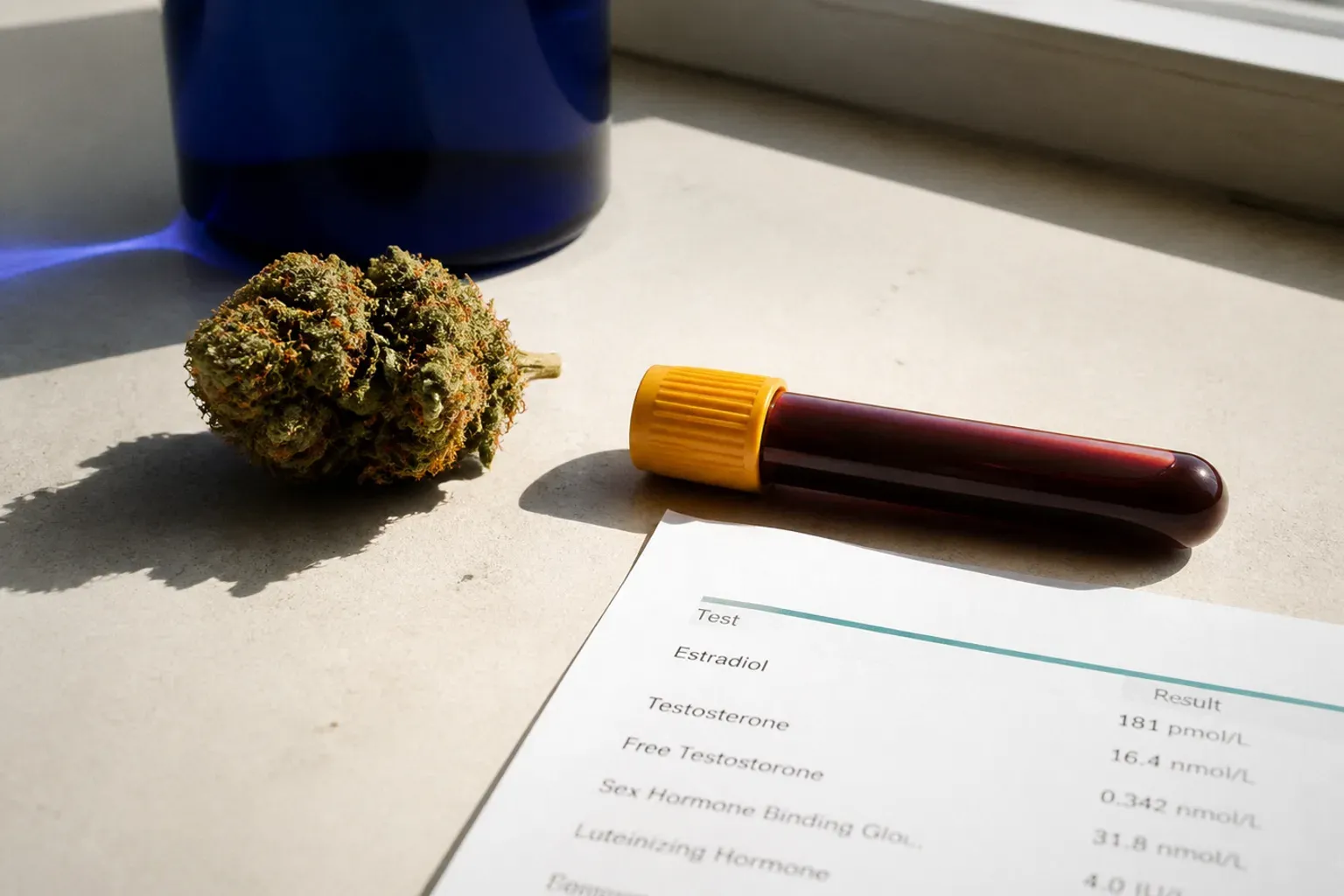
Cannabis and Testosterone in Men: What Marijuana Does to Hormone Levels, Sperm Counts and Erections
The old warning was that marijuana shrinks testosterone. The modern studies, with thousands of men and mass spectrometry blood tests, tell a stranger story: hormone levels barely move, while sperm counts and erections are where the real questions sit.
Cannabis does not appear to lower testosterone in most men. A survey of 1577 US men found nearly identical average levels in users and never users, and a meta-analysis of nine studies found no significant difference. Sperm counts and erectile function are less settled, with frequent use linked to lower sperm counts in one large Danish study.
Does cannabis lower testosterone? For most men, the best current evidence says no. In a US government analysis of 1577 men from the 2011-2012 NHANES survey, published in Andrology in 2017, men who had ever used marijuana had an adjusted mean testosterone of 3.69 ng/mL, against 3.70 ng/mL in men who never had. A 2021 meta-analysis of nine studies also found no significant testosterone difference between cannabis users and non-users.
The link between cannabis and testosterone is still worth understanding, because hormones are only one part of male reproductive health. Frequent marijuana use was tied to lower sperm counts in a study of 1,215 young Danish men, while a Harvard fertility clinic study found the opposite. Erectile dysfunction looks more common in users in case-control studies, but genetic analysis has not confirmed cause and effect. This guide walks through each finding, using only studies opened and checked for this article.
3.69 vs 3.70
Testosterone, ng/mL
Ever users vs never users among 1577 US men (Thistle, Andrology 2017)
Nine studies
No Significant Testosterone Gap
4787 men with hormone data, SMD -0.139, P = 0.318 (Belladelli, Andrology 2021)
28% lower
Sperm Concentration
In men using more than once per week, 1,215 Danish men (Gundersen, Am J Epidemiol 2015)
OR 3.83
Erectile Dysfunction Odds
Five case-control studies with very high heterogeneity (Pizzol, Am J Mens Health 2019)
No causal link
Genetic Analysis
Mendelian randomization found no effect on ED or sex hormones (Zhang, Int J Impot Res 2025)
Does Cannabis Lower Testosterone?
Cannabis does not lower average testosterone in the large modern studies. The 2017 NHANES analysis by Thistle and colleagues at the National Cancer Institute measured testosterone with isotope dilution liquid chromatography tandem mass spectrometry, the most accurate lab method available. In that weighted sample, 66.2% of men reported ever using marijuana and 26.6% reported current use. After adjusting for other factors, ever users and never users had virtually the same testosterone level.
Adjusted Mean Serum Testosterone, Ever vs Never Marijuana Users (Source: Thistle et al., Andrology 2017, NHANES 2011-2012, 1577 men)
The NHANES data held one surprise. Testosterone was higher in men with more recent marijuana use, not lower, and the relationship was strongest in men aged 18-29. The authors concluded that recency of use, and not duration or frequency, had the strongest relationship with testosterone levels. A cross-sectional survey cannot show why, and it cannot rule out that men with higher testosterone are simply more likely to use cannabis.
Pooled data point the same way. Belladelli and colleagues, writing in Andrology in 2021 with a team from Stanford and Copenhagen, combined nine studies covering 4787 men with hormone data. The standardized mean difference in testosterone between users and non-users was -0.139, with a P value of 0.318, which is not statistically significant. The authors wrote that current evidence does not suggest clinically significant associations between cannabis use and testicular function, while noting they could not exclude an effect.
Why Do Some Studies Show Higher Testosterone in Cannabis Users?
Several studies found higher testosterone in cannabis users, and the reason is not settled. In the 2015 Danish study of 1,215 men aged 18-28, Gundersen and colleagues reported that marijuana smokers had higher testosterone, within the same range as cigarette smokers. In a Swiss cohort published in Andrology in 2024, Zufferey and colleagues found that androgens, estradiol and SHBG were all higher in cannabis users, particularly in chronic, recent and CBD-positive users.
The Swiss team found no significant difference in gonadotropins, the pituitary hormones LH and FSH that tell the testes to make testosterone. Prolactin was lower in users. Because SHBG rose along with total testosterone, the extra testosterone in cannabis users may not translate into more free, active hormone. Our guide to SHBG and free versus total testosterone explains why that distinction matters.
Illustration: Where Cannabinoids Meet the Testosterone Axis
Brain
Hypothalamus
Cannabinoid receptors are present here and respond to THC and CBD.
Pituitary
LH and FSH
The pituitary sends LH for testosterone and FSH for sperm production.
Testes
Hormones and sperm
Leydig cells make testosterone; Sertoli cells support sperm.
Blood
What a lab measures
Total testosterone, SHBG, estradiol and gonadotropins.
The biology explains why researchers expected an effect. Zufferey and colleagues note that cannabinoid receptors are activated by THC and CBD at each level of the hypothalamus-pituitary-gonadal axis. The human data simply have not shown that this translates into lower testosterone for the average user.
Can Genetics Tell Whether Cannabis Causes Hormone Changes?
A genetic study found no evidence that cannabis use causes changes in sex hormones. Zhang and colleagues used Mendelian randomization, a method that uses inherited gene variants as a natural experiment, with data from FinnGen and UK Biobank, published in the International Journal of Impotence Research in 2025. They found no causal relationship between cannabis use disorder or lifetime cannabis use and bioavailable testosterone, estradiol, FSH or LH.
Mendelian randomization avoids some of the confounding that plagues surveys, such as the fact that cannabis users may also drink, smoke or sleep differently. The method relies on assumptions about the gene variants it uses, so it adds weight to the observational findings rather than replacing a randomized trial. No randomized trial of cannabis and testosterone in older men has been run.
Does Marijuana Lower Sperm Count?
Frequent marijuana use was linked to lower sperm counts in one large study, but other studies disagree. In the Danish study by Gundersen, published in the American Journal of Epidemiology in 2015, 45% of the 1,215 young men had smoked marijuana within the last 3 months. Smoking more than once per week was associated with a 28% lower sperm concentration and a 29% lower total sperm count after adjustment. Men who combined weekly marijuana with other recreational drugs had a 52% lower concentration and a 55% lower total count.
Lower Sperm Measures in Danish Men Using Marijuana More Than Once Per Week (Source: Gundersen et al., Am J Epidemiol 2015, 1,215 men)
A Harvard study pointed the other way. Nassan and colleagues followed 662 men at the Massachusetts General Hospital Fertility Center between 2000 and 2017, reported in Human Reproduction in 2019. The 365 men who had ever smoked marijuana had an adjusted sperm concentration of 62.7 million/mL, compared with 45.4 million/mL in the 297 never users. The authors cautioned that the men were patients at a fertility clinic, so the result may not generalize, and that chance findings could not be excluded.
Adjusted Sperm Concentration in Fertility Clinic Patients (Source: Nassan et al., Hum Reprod 2019, 662 men)
The largest recent dataset found little either way. In 2025, Khoury and colleagues studied 1058 young men from the Danish National Birth Cohort in Reproductive Toxicology. Of the analyzed group, 721 men (59%) had used cannabis at least once. Ever use showed no association with semen volume, concentration, count, motility, morphology or DNA fragmentation. The only signal was slightly higher FSH among users, about 8%, which the authors said could hint at early changes in testicular function and needs confirming.
How Do the Main Cannabis and Male Fertility Studies Compare?
The main studies on cannabis and male reproductive health differ in who they enrolled and how they measured use, which helps explain the mixed results. Most were done in men under 30, so the findings for men over 40 are an extrapolation.
Key Studies on Cannabis, Testosterone and Sperm in Men
| Study | Men studied | Testosterone finding | Sperm or FSH finding |
|---|---|---|---|
| Thistle, Andrology 2017 | 1577 US men, NHANES | 3.69 vs 3.70 ng/mL, no difference | Not measured |
| Gundersen, Am J Epidemiol 2015 | 1,215 Danish men aged 18-28 | Higher in marijuana smokers | 28% lower concentration with use more than once per week |
| Nassan, Hum Reprod 2019 | 662 fertility clinic patients | No difference | Higher concentration; FSH 16% lower |
| Belladelli, Andrology 2021 | Nine studies, 4787 with hormone data | SMD -0.139, not significant | Abnormal semen RR 1.159, not significant |
| Khoury, Reprod Toxicol 2025 | 1058 young Danish men | No association | No semen association; FSH about 8% higher |
| Zhang, Int J Impot Res 2025 | FinnGen and UK Biobank genetic data | No causal effect on bioavailable testosterone | No causal effect on FSH or LH |
In the Belladelli meta-analysis, 44.9% of 1158 cannabis users had impaired semen parameters, compared with 24.5% of 2856 non-users. That raw gap looks large, but after pooling the studies properly the relative risk was 1.159 and not statistically significant. Raw percentages from mixed studies can mislead, which is why the pooled estimate is the better number to rely on.
Does Cannabis Cause Erectile Dysfunction?
Cannabis users report more erectile dysfunction in some studies, but cause and effect has not been shown. Pizzol and colleagues pooled five case-control studies of 3,395 healthy men, 1,035 of them cannabis smokers, in the American Journal of Men's Health in 2019. Erectile dysfunction was present in 69.1% of cannabis users and 34.7% of controls, and the odds ratio was 3.83.
Prevalence of Erectile Dysfunction in Case-Control Studies (Source: Pizzol et al., Am J Mens Health 2019, five studies, 3,395 men)
The Pizzol result comes with heavy caveats. Heterogeneity between the five studies was very high, with an I2 of 90%, and the prediction interval overlapped 1.00, meaning a future study could plausibly find no difference. A larger 2018 meta-analysis of lifestyle factors by Allen and Walter in the Journal of Sexual Medicine, covering 89 studies and 348,865 people, concluded that there was insufficient research to call cannabis a risk factor for erectile dysfunction. The 2025 Mendelian randomization study also found no causal link, with an odds ratio of 0.97 for cannabis use disorder and 1.13 for lifetime use, neither significant.
For men over 40, the stronger evidence on erections concerns other habits. Allen and Walter found that cigarette smoking, alcohol intake and physical activity had dose-dependent associations with erectile dysfunction. Smoking cannabis mixed with tobacco brings the tobacco risk with it, and erectile problems after 40 can be an early sign of blood vessel disease, which our guide on erectile dysfunction as a heart warning sign covers in detail.
What Should Men Over 40 Who Use Cannabis Do About Testosterone?
Men over 40 who use cannabis and worry about testosterone should get a proper morning blood test rather than assume cannabis is the cause. The research does not show that cannabis lowers testosterone on average, so a low result points to other causes worth checking, such as weight, sleep, alcohol, opioids or medical conditions. Our guide to testing testosterone accurately covers timing and fasting rules.
Illustration: A Practical Check for Men Who Use Cannabis
Step 1
- ✓Book a morning fasting testosterone test
- ✓Ask for SHBG and free testosterone if total is borderline
Step 2
- ✓Report how often you use and how
- ✓Mention tobacco, alcohol and other drugs
Step 3
- ✓Ask about a semen analysis
- ✓Consider cutting back on frequent use while trying to conceive
Step 4
- ✓Check weight, sleep and alcohol
- ✓Repeat a low result before acting on it
If you are trying to conceive, the picture is less reassuring than it is for hormones. The Danish data link weekly use to lower sperm counts, and the Swiss and Danish cohorts found shifts in FSH and other markers that researchers have not explained. Cutting back while trying for a pregnancy is a reasonable precaution, even though the evidence is not conclusive. Our article on sperm quality after 40 covers the age-related factors that matter more.
Most Research Was Done in Young Men
Nearly every study on cannabis and testosterone enrolled men in their teens, twenties or early thirties, or fertility clinic patients. None tested older men directly in a controlled trial. The findings are the best available guide, but they should not be read as proof of what cannabis does to a 50-year-old man's hormones.
This article is for educational purposes only and is not medical advice. It does not diagnose, treat, cure or prevent any disease. Speak with a doctor about symptoms of low testosterone, fertility concerns or erectile problems.
Sources
- Thistle JE et al. Marijuana use and serum testosterone concentrations among U.S. males. Andrology, 2017. https://doi.org/10.1111/andr.12358
- Gundersen TD et al. Association Between Use of Marijuana and Male Reproductive Hormones and Semen Quality: A Study Among 1,215 Healthy Young Men. American Journal of Epidemiology, 2015. https://doi.org/10.1093/aje/kwv135
- Belladelli F et al. The association between cannabis use and testicular function in men: A systematic review and meta-analysis. Andrology, 2021. https://doi.org/10.1111/andr.12953
- Nassan FL et al. Marijuana smoking and markers of testicular function among men from a fertility centre. Human Reproduction, 2019. https://doi.org/10.1093/humrep/dez002
- Khoury G et al. Ever cannabis use and biomarkers of male fecundity - A study in the Danish National Birth Cohort. Reproductive Toxicology, 2025. https://doi.org/10.1016/j.reprotox.2025.109004
- Zufferey F et al. Gonadotropin axis and semen quality in young Swiss men after cannabis consumption: Effect of chronicity and modulation by cannabidiol. Andrology, 2024. https://doi.org/10.1111/andr.13440
- Zhang Y et al. The impact of cannabis use on erectile dysfunction and sex hormones: a Mendelian randomization analysis. International Journal of Impotence Research, 2025. https://doi.org/10.1038/s41443-024-00925-3
- Pizzol D et al. Relationship Between Cannabis Use and Erectile Dysfunction: A Systematic Review and Meta-Analysis. American Journal of Men's Health, 2019. https://doi.org/10.1177/1557988319892464
- Allen MS, Walter EE. Health-Related Lifestyle Factors and Sexual Dysfunction: A Meta-Analysis of Population-Based Research. Journal of Sexual Medicine, 2018. https://doi.org/10.1016/j.jsxm.2018.02.008
Continue Reading
Related Articles

SHBG: Why Your Total Testosterone Looks Normal and You Still Feel Flat
12 min read

Sperm Quality After 40: What Paternal Age Really Changes and What You Can Control
11 min read

Erectile Dysfunction as an Early Warning Sign for Heart Disease in Men Over 40
11 min read